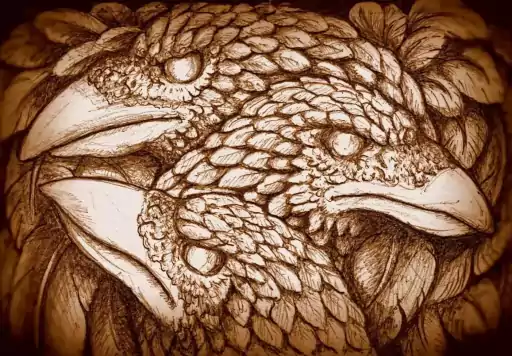
In Therapeutic Shamanism, a Power Animal is the Lower-World Oversoul of a wild animal species, the whole species met as one wise being (Panther, Wolf, Eagle), with whom a person chooses to form a deep, committed and usually lifelong bond. It is not an individual animal, not a pet, and not one of the many animal helpers met in journeys. Its love is unconditional, and the bond heals Power-loss, our disconnection from nature and Mother Earth.
What does “Power Animal” mean, and how is it different from a spirit animal or totem? #
There is no agreed shamanic vocabulary. Western culture killed off its shamans and lost their precise terminology, so “power animal”, “spirit animal” and “animal helper” are now used loosely, often interchangeably, by modern shamanic practitioners and in New Age circles.1 Therapeutic Shamanism gives each term a specific meaning.
Journeying brings meetings with many animals, some fleeting, some lasting months, years or a lifetime. These are animal helpers, guides and teachers, sometimes called animal totems elsewhere, and they can be loved deeply, but they are not a Power Animal. In Paul Francis’s words, “Think of the difference between friends on the one hand, and a lifelong, committed, deep soul bond on the other.” The Power Animal, if a person chooses to enter into that relationship, is a bond of a different depth, intensity, loyalty and love.
Is my Power Animal an individual animal? #
No. In the Lower-World, what we meet are not individual creatures but the Oversouls of the Peoples, and a Power Animal is the Oversoul of its species. Individuality is a characteristic of the middle-world, and wholeness a characteristic of the Lower-World.2 In The Shamanic Journey, Paul Francis puts it in terms of his own Power Animal, Panther, writing that “if I think of it as Panther, in terms of being all panthers, the sum of all the individuals in the species, what we call the Oversoul … then I am relating to an infinitely wiser and more powerful being.”
What is an Oversoul? #
An Oversoul is a branch of Mother Earth in the Lower-World that represents the whole of a species. Each individual fox is a twig projecting into the middle-world from the Fox Oversoul, “the Great Fox that all individual foxes come from”, and the thicker branches nearer the trunk of the great tree of the Peoples are Oversouls too, of a whole genus, family or class. See What is an Oversoul?
Why does language matter when referring to a Power Animal? #
A journey is co-created, and the words a person uses shape what they meet. Calling the Power Animal “my panther” makes the bond one with a limited middle-world individual; calling it Panther makes it one with the transcendent Lower-World being.3 Hence the capitals in Power Animal, Panther, Horse or Wolf, explained in The Shamanic Journey as “Lowercase means of the middle-world, uppercase of the lower-world or upper-world”, and the habit of dropping “a”, “the” and “my”. So “Bear appeared”, not “a bear appeared”, since “Using ‘a’, ‘the’ or ‘my’ reduces Animal to animal.”
What is a relationship with a Power Animal like? #
The Shamanic Journey calls the bond a sacred marriage, and passes on a description its author read somewhere and could not later trace, that the Power Animal is Mother Earth trying to tell you, in a form she thinks you will understand, how deeply she loves you and how welcome you are on the Earth.4 The Power Animal is already fully committed, so how far the bond grows is up to the person. Human relationships are conditional; a Power Animal loves unconditionally, will never abandon you, and shows more love and compassion than most people show themselves. This is how it helps heal self-criticism and “the deep Mother wound” of disconnection from nature. It may still tease, chide or be stern, as a good mother can.
It is the most important of a practitioner’s Guides. A shaman’s power comes not from the shaman but from the bond with their Guides, so the Power Animal leads every journey, with the practitioner as its apprentice, and goes with them into every realm and into daily life. See What is the role of Power Animal in shamanic journeying?
What is the relationship between a Power Animal and Power-loss? #
By “power” shamans mean life-force, and Power-loss is the weakening of it that comes from cutting ourselves off from nature and Mother Earth. It has been endemic since the move to agriculture, around 11,000 BC, away from the way our hunter-gatherer ancestors lived, as one part of an interconnected web of life. A Power Animal is the primary and most powerful means of connecting back to that web, and that is why it is called a Power Animal.5 See What is Power-loss?
How do I find my Power Animal? #
A Power Animal is met by journeying to the Lower-World with a clear intent to meet it, and is then brought back to be present in everyday life, a process called a Power Animal retrieval. It is recognised by asking it, by its showing itself clearly, by its staying close, or by a simple knowing. What makes it a Power Animal, not just another helper, is the choice to commit to it. See How do I find my Power Animal?
Can my Power Animal have a gender, age or name? #
Not as an individual would. Because a Power Animal is the whole species, it is both male and female, and both old and young. Giving it a name and a personality turns it into an individual, middle-world being, with that being’s limits. Human Lower-World Guides, by contrast, are met with a name and a face, because we are so wired to recognise faces as individuals, although they too are faces of something much larger.
Can an individual pet or animal I knew in life be my Power Animal? #
No. A beloved dog, cat or horse, living or dead, is more correctly called a familiar. A familiar can be a dear companion, even on journeys. It is a middle-world being, though, with middle-world limits, and “The animal Oversouls in the lower-world are of a totally different league altogether.”
Can my Power Animal be a domesticated animal? #
No. A Power Animal is a Lower-World being, and the Lower-World is nature as it was before farming, with no fields, no hedges and no domesticated animals. A Power Animal is therefore a wild species.
Should I worship my Power Animal? #
No. The relationship is a marriage and an apprenticeship, within an animist family of Peoples that “is not about hierarchy, but about family”. Our hunter-gatherer ancestors respected and honoured even the gods without worshipping them; gods who demand worship are the human-made gods of the Fall.6 ⚑ [For Paul: no published passage says in terms “do not worship your Power Animal”; this answer is built from Book 2 Ch1, Book 3 Ch1 and Book 1 Ch5 and Ch10] What the relationship asks for instead is gratitude, given with no strings attached, and reciprocity. As The Shamanic Journey puts it, “We simply cannot ask an Oversoul like Panther or Wolf to teach us and heal us, and then ignore the plight of physical panthers and wolves in the middle-world.”
Can I have more than one Power Animal? #
It is possible, but uncommon. Most people can have many friends but find one deep, committed primary relationship more than enough, because such relationships take time, tending and dedication, and the same holds here. For a smaller number of people a second Power Animal arrives, usually several years later.
Can my Power Animal change? #
There are no absolute rules. Animals do come and go at different stages of a life, and some practitioners say a Power Animal changes as each chapter closes. In Therapeutic Shamanism, though, a Power Animal is defined by commitment, and a bond that is chosen and tended is likely to be lifelong. The Shamanic Journey observes that many practitioners who claim constantly changing Power Animals seem to have commitment issues in their human relationships too.
Can my Power Animal be mythical? #
Mythical Animals are fine to work with in journeys, but they do not always make good Power Animals. Some, especially flying ones such as Pegasus, Griffin and Thunderbird, have a more rarefied, Upper-World quality, whereas a Power Animal needs to connect a person both to the Lower-World and to nature. What usually works best is an Animal that also exists as a real, flesh-and-blood animal here, because the Power Animal is the bridge between this reality and the shamanic realms. There are “no rules, only guidelines”, and one or two good practitioners do work with mythical Power Animals.7
Can my Power Animal be prehistoric or extinct? #
Yes. Animals that became extinct in human times, and of which we keep an ancestral memory, make good Power Animals: Mammoth, Giant Sloth, Cave Bear, Cave Lion, Auroch, Woolly Rhinoceros and so on. They were once flesh-and-blood animals, and it is not long, in the scale of things, since they lived on the Earth. Their bones, teeth and bodies in the permafrost are still with us, and our hunter-gatherer ancestors painted them on cave walls.8